
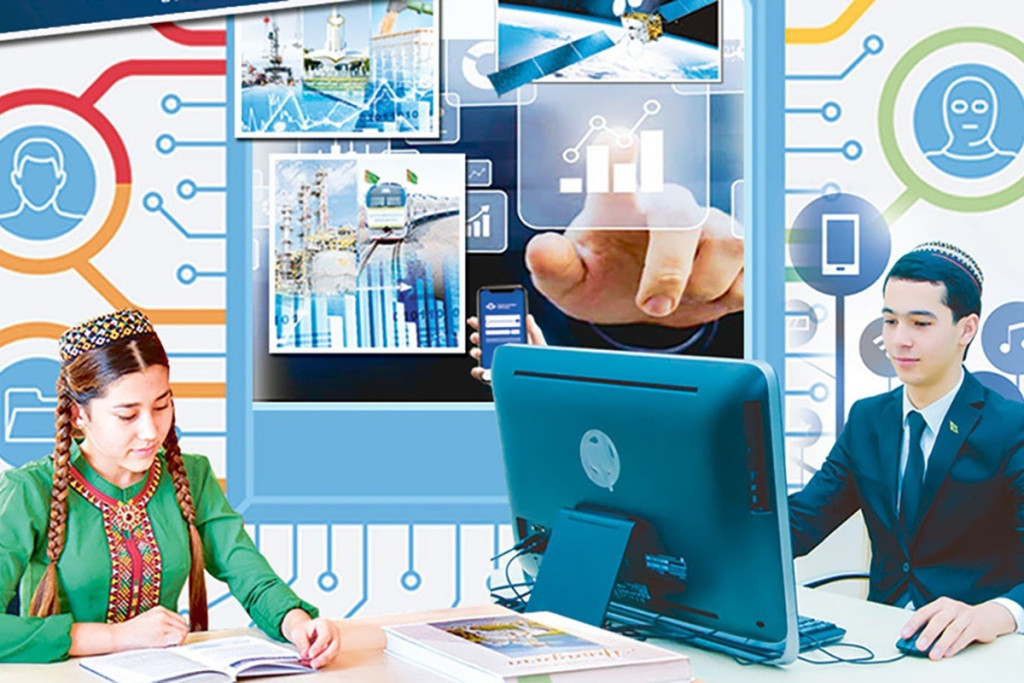
At present, Turkmenistan is successfully continuing the implementation of digital system capabilities across all sectors. The country is actively pursuing the wide adoption of modern information and communication technologies and artificial intelligence, ensuring their coordinated operation, protecting information, and further developing the support system. All of this provides citizens with access to new digital services, simplifies daily life, and enhances the development and competitiveness of the national economy’s sectors.
During the working visit of the President of Turkmenistan to the United States, business forums were held, including “Turkmen-American Business Cooperation: New Opportunities and Prospects” and the forum dedicated to the 10th anniversary of the “Central Asia — United States” cooperation format. At these forums, both sides emphasized the importance of activating cooperation in areas such as high technologies, digitalization, cybersecurity, communications, and digital infrastructure. This is highly significant for the implementation of the “Concept for the Development of the Digital Economy in Turkmenistan for 2026–2028,” approved by the President. At the same time, it will contribute to the development of the digital system, ensure the operation of intelligent systems, expand data transmission networks and internet services, strengthen international cooperation, and attract investments.
In an era of rapidly advancing technologies, the introduction of the latest nanotechnology devices into human life creates opportunities to accelerate economic growth. Among these, particular importance is given to artificial intelligence. The possibilities for the wide integration of AI technologies into key economic sectors, including finance, agriculture, energy, and public administration, are continuously being explored.
Today, hundreds of millions of people worldwide benefit from digital technologies and eagerly anticipate innovations. Thousands are interested in current and future development trends in this field. Some are thinking about generating new ideas and determining in which areas these technologies will be most effective. Artificial intelligence is one of the most important directions for the development of human society. Therefore, it is interesting for all of us to see what innovations it will bring in the near future.
In the modern world, artificial intelligence has become one of the key driving forces of digital transformation. Today, it is not only a subject of scientific research but also a fundamental tool for the development of society, the economy, and public administration. Over several decades, when this technology existed mostly at a theoretical level, it has now become a real force affecting the daily lives of billions of people. The implementation of AI goes beyond computer programs. Today, it is widely used in healthcare, logistics, education, energy, the banking system, public services, and the arts. At the same time, issues of ethics, employment, and information security are actively discussed.
Over the past ten years, artificial intelligence technologies have developed at a rapid pace. Most tasks previously performed by humans are now carried out by “smart” algorithms. The main areas influencing modern AI development include the widespread use of big data, the application of more powerful computing resources, the development of self-learning algorithms, and increased investments from major companies in this sector.
Today, AI is implemented through accessible and highly effective platforms such as OpenAI, Google DeepMind, Anthropic, Microsoft Copilot, Midjourney, and DALL·E, which are widely used around the world.
One of the most discussed topics is AI’s impact on the labor market. Even now, some professions are being automated, but at the same time, new ones are emerging: AI engineers, data analysts, cybersecurity specialists, AI ethics experts, and programmers developing AI technologies. It is forecasted that by 2030, around 300 million jobs worldwide could be automated.
According to experts, by 2035, AI will contribute more than 15 trillion dollars to the global economy. In the future, AI will not only process information but will also think ethically and creatively. Some scientific centers predict that by the mid-21st century, “superintelligent” AI could emerge. Currently, the key issues involve AI’s alignment with moral and ethical values, as the cultural diversity of societies complicates this challenge. Therefore, the use of AI should be guided by certain cultural norms. Since the application of digital technologies is linked to the work of state institutions, their approach to these issues can influence development in various ways.
In the future, AI may lead to the automation of most work processes, collaboration with AI, personalized education, precise diagnostics, development of drugs and treatment methods, creation of individualized treatment and nutrition plans for the elderly and for disease prevention, and the advancement of digital creativity. In this context, it is worth noting that Turkmenistan’s delegations participate in international forums dedicated to AI and its possibilities, exchange experience, and gain positive practices. In addition, in November this year, the capital hosted the III Turkmen-Chinese Scientific and Innovation Forum “Innovations, New Technologies, and Their Implementation in Production.” This is further evidence that the country is open to international cooperation with the world’s scientific centers in science, technology, and innovation and demonstrates state support for the development and active implementation of innovative technologies in economic sectors.
Tyllа Amandurdyeva,
Programmer, “Digital News” section, Editorial Office of the Journal “Oil, Gas and Mineral Resources of Turkmenistan”, SC “Turkmennebit”
Source: State Concern "Turkmennebit"